20 September 2026 · Chirinkito
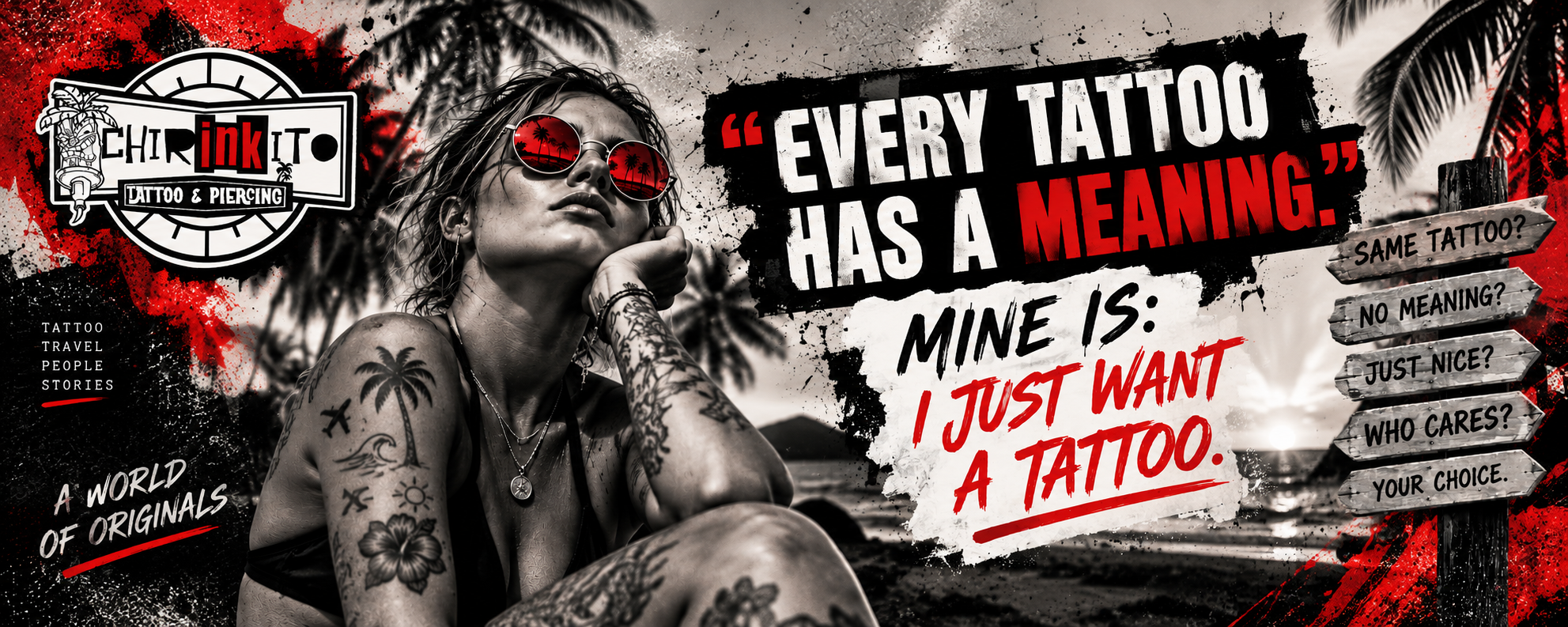
"Every Tattoo Has a Meaning." Mine Is: I Just Want a Tattoo.
We have somehow decided that every tattoo needs a story.
A lost loved one. A life-changing journey. A date. A name. Coordinates. A symbol that only three people on Earth understand.
Ask someone why they got their tattoo and, increasingly, there seems to be an expectation that they should have a meaningful answer.
But what if they don't?
What if the answer is simply: "I liked it."
Or even: "It looked fucking cool."
Is that really not enough?
The Tattoo That Doesn't Need a Story
There is a strange pressure around tattoos today to make them mean something.
Social media is full of posts explaining the deep personal meaning behind someone's tattoo. And there's nothing wrong with that. For many people, that's exactly why they get tattooed.
But tattoos are also visual.
People put art on their bodies because they like the way it looks. Nobody asks someone why they bought a painting and demands to know which childhood trauma it represents.
Sometimes you like the colours. Sometimes you like the shape. Sometimes you like the way it looks on skin. Sometimes you simply see something and think: "Yeah. I want that."
That's a perfectly valid reason.
But What About Getting Something You've Seen Online?
Now we get into more complicated territory.
Someone finds a tattoo on Instagram or Pinterest. They love it. They show it to their tattoo artist and say: "I want exactly this."
For the client, there may be nothing wrong with that. They aren't trying to pretend it has some profound personal meaning. They aren't claiming to have invented it. They simply found something they liked.
And that's where another philosophy of tattooing enters the conversation.
For many artists, the exciting part isn't reproducing an image. It's taking an idea and turning it into something that belongs to the person sitting in the chair.
Change the composition. Change the proportions. Add something personal. Remove something that doesn't work. Adapt it to the body. Change the style. Take the original idea somewhere else entirely.
The starting point might be the same. The destination doesn't have to be.
So Which One Is the "Right" Tattoo?
That's where things get uncomfortable. Because there isn't necessarily a right answer.
Some people genuinely don't care if another person has the same tattoo. Others absolutely do.
One person might say: "I don't want something anyone else has."
Another might say: "I don't care if a million people have it. I love it."
Neither person is necessarily wrong. The tattoo belongs to the person wearing it. And perhaps we've become too obsessed with deciding what a tattoo should represent.
Enter the Holiday Tattoo
This gets particularly interesting when you travel.
You arrive somewhere sunny. You have a few days. You walk past tattoo studios. You see palm trees, waves, flowers, compasses, little symbols of the destination.
And eventually someone will make the inevitable comment: "Oh, everyone gets that tattoo when they're on holiday."
And?
Maybe they do. Maybe 500 other tourists have that palm tree. Maybe another 500 will get one next summer.
But the person sitting in the chair might be having the time of their life. They might have spent two weeks on the island with their partner. Maybe it's their first trip together. Maybe they're celebrating something.
Or maybe they just looked at the design and thought: "That's a fucking nice palm tree."
We don't actually know. And we probably don't need to.
Then There's the Business of Tattooing
There is another side to this conversation that we don't talk about as much.
Tattooing is also a business.
Particularly in busy tourist destinations, studios can have a constant stream of people looking for something relatively quick. A flash design can be chosen quickly. The artist already knows how to tattoo it. The client doesn't need three consultations. The drawing process is minimal. The tattoo takes less time. And another client can get into the chair.
From a purely commercial point of view, that makes sense.
And flash isn't some modern invention created to exploit tourists. Flash has been part of tattoo culture for generations.
The problem isn't necessarily the existence of flash. The interesting question is what happens when speed becomes more important than creativity.
Because custom tattooing takes time. Talking to the client takes time. Understanding what they want takes time. Drawing takes time. Changing things takes time.
Sometimes the artist has to say: "No, that won't work there." Sometimes they have to redraw the entire thing. And sometimes the result is something neither the artist nor the client expected when they first walked through the door.
That's where tattooing becomes more than simply applying an image to skin.
The Artist Doesn't Always Want the Same Thing as the Client
This is another part people often overlook.
A client might want the exact tattoo they've found online. The artist might see an opportunity to create something completely different.
Neither perspective is automatically more important. The client is the one who has to live with the tattoo. The artist is the one putting their name and years of experience behind it.
The best outcome probably starts with both understanding what the other actually wants.
If you want the exact little palm tree you found online, say so. If you want the artist to create their own version, say so. If you don't care either way, say that too.
There is nothing wrong with knowing what you want.
Maybe the Meaning Is the Choice
Perhaps we have been looking at the question backwards.
A tattoo doesn't necessarily need a meaning before you get it. Maybe the meaning comes afterwards.
The design might remind you of the holiday. The stupid decision you made with your best friend. The summer when you finally stopped worrying about what everyone else thought. The random Tuesday afternoon when you walked into a studio and decided to do something completely impulsive.
Or perhaps it never acquires some profound meaning at all. It remains exactly what it was on the day you got it: something you wanted on your skin.
And that's enough.
So, Does Every Tattoo Need a Story?
No. And yes. And maybe that's the point.
Your tattoo can represent someone you love. It can commemorate a moment that changed your life. It can be designed specifically around your story. It can be something you've seen online and simply couldn't stop thinking about. It can be a flash design. It can be completely original. It can be deeply meaningful.
Or its entire meaning can be: "I wanted a tattoo."
There isn't a tattoo police force coming to check your explanation. There is only you, your skin, the artist, and the decision you made.
So if someone asks you what your tattoo means, you can tell them the whole story.
Or you can just say: "Mine? I just wanted a tattoo."
And honestly? That's a pretty good story too.